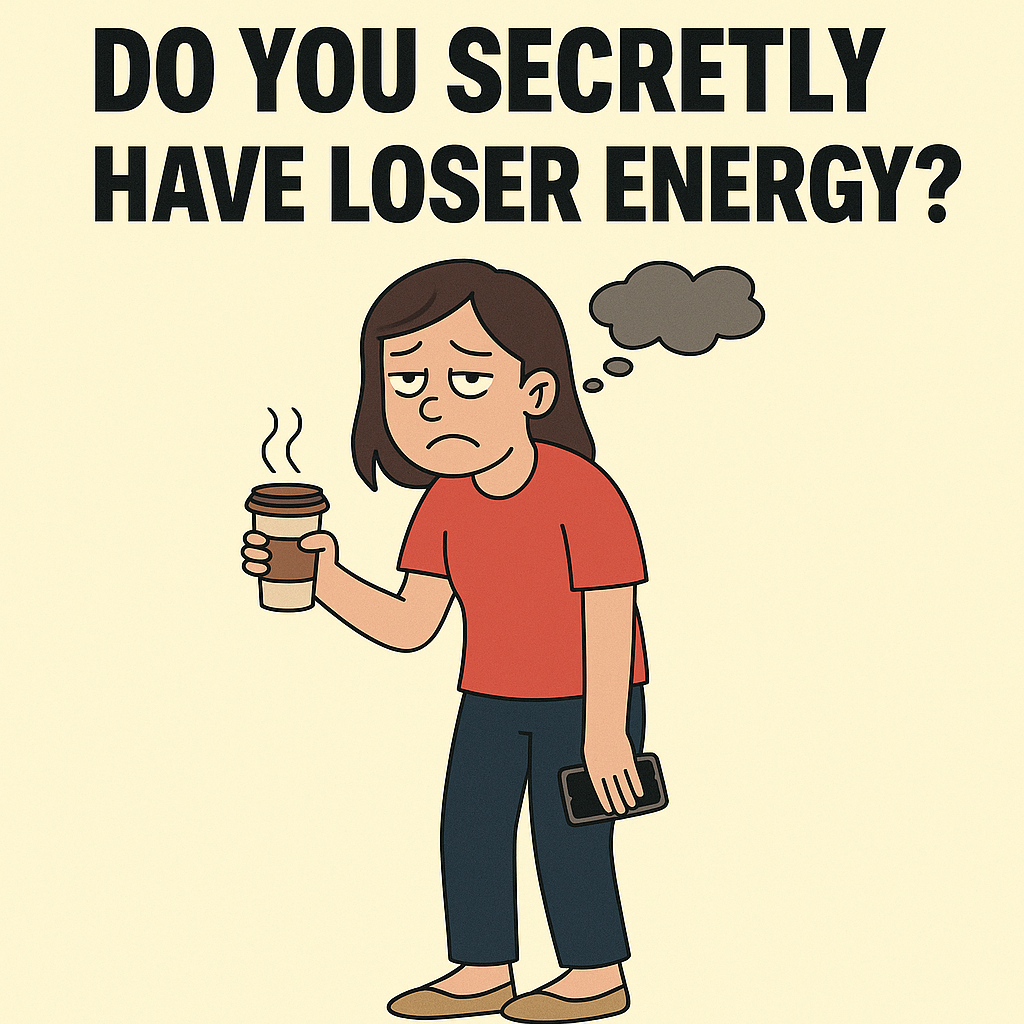
Do You Secretly Have Loser Energy?
You can have a good title, a solid salary, and a reputation for hard work and still be running on it.
Loser energy is not about losing.
Loser energy is a set of patterns. The way you position yourself in rooms. The way you respond to setbacks. The story you carry about how organizations work and where you fit in them. It signals low leverage before you open your mouth, and it tends to compound quietly until something breaks.
Most people with loser energy do not know they have it. That is what makes it expensive.
What Loser Energy Actually Is
It is not negativity. It is not a bad attitude. People with loser energy are often the hardest workers in the room. They are often the most competent. They are often the ones who stay late, produce clean work, and never cause problems.
What they do not do is operate as if they have leverage.
Loser energy is the operating assumption that your outcomes are solely determined by other people. That the way to get ahead is to do good work and wait. That if you just stay out of trouble and keep delivering, things will work out. That you need to hide your ambition to be acceptable. That asking for what you want is aggressive or entitled.
These assumptions feel like humility. They are not. They are a framework for low-leverage positioning, and organizations will price you exactly as low as you allow.

The Patterns
You explain yourself when no one asked. Someone makes a decision that affects you, and you send a three-paragraph email explaining your perspective on why it should have gone differently. Nobody requested your perspective. The decision is made. You sent the email anyway because you needed to be understood.
This is loser energy. Not because your perspective is wrong, but because the move reveals that you believe your value lies in being right rather than in being positioned. The person who got the thing you wanted did not send an explanation. They built relationships before the decision was made.
You treat visibility as a reward for performance. The logic goes: I do excellent work, people will notice, and I will be recognized. This is the most common losing strategy in corporate America. It outsources your career to other people's attention, which is a finite and competitive resource.
Visibility is not a reward. It is a strategy. The people moving up are not waiting to be noticed. They are engineering notice. They are presenting work in rooms where decisions get made. They are cultivating the relationships that generate sponsorship. They are choosing projects for visibility, not just for quality. That is not political. That is operational.
You process setbacks as verdicts. You didn't get the promotion. You got passed over for the project. Your idea got shut down in the meeting. People with loser energy absorb these as signals about their worth. The correct read is that they are signals about the current configuration of relationships, timing, and positioning — all of which are adjustable.
A setback is data. It tells you something about where you stand in the system right now. It says nothing definitive about what is possible. The response to a setback is analysis and adjustment, not acceptance or resentment. Both acceptance and resentment are ways of handing the outcome to someone else.
You confuse effort with leverage. This is a big one, especially for women. Loser energy often comes wrapped in a work ethic. The person who is first in and last out, who takes every project that lands in front of them, who never says no because they believe availability equals value. This person is not building leverage. They are building a reputation as a resource — available, useful, and easy to direct. Resources get utilized. They do not get promoted.
Leverage comes from being scarce in the right ways, not from being available in all ways.
You read the room as a meritocracy. This is the core belief underneath most loser energy: that better work produces better results. That if you keep your head down and your output high, the system will eventually deliver what you've earned. This is a trap.
Organizations are not meritocracies; they are political economies. They reward people who understand how resources, relationships, and decisions actually move, and who operate accordingly. This is not a cynical statement. It's an operational one. The people doing well in organizations are not doing well because they work harder. They are doing well because they are playing the actual game.
Why Smart, Competent People Have Loser Energy
The most counterintuitive thing about loser energy is that it shows up most often in people who are genuinely good at their jobs.

That is because the skills that make someone excellent at individual contribution — precision, diligence, reliability, humility — are not the skills that generate organizational leverage. The move from strong performer to positioned player requires a completely different set of capabilities: strategic relationship building, visibility engineering, reading power structures, and knowing when and how to use informal channels. These are not taught. They're rarely modeled explicitly. And for people who have built their identity around competence, developing them can feel like selling out.
It is not selling out. It is fluency in the language of Power, which is the only language the organization actually speaks.
What the Shift Looks Like
Losing loser energy does not mean becoming someone who plays politics or performs confidence they don't feel. It means updating your operating assumptions.
The update: your outcomes are not predetermined by your performance. They are a function of your positioning, your relationships, and how visible the right work is to the right people. All of those are things you can influence deliberately.
That means choosing projects for their proximity to decision-makers, not just their internal value. It means building relationships laterally and upward before you need them. It means making your work visible to the people it needs to reach, not waiting for it to be discovered. It means treating setbacks as positioning problems, not verdicts.
It means showing up in rooms as someone who expects to be taken seriously — because you have done the work to earn that position structurally, not just on paper.

The Honest Question
Most people reading this already know whether any of this applies to them. The patterns are recognizable. The question is whether you have been calling them something else — professionalism, humility, patience, staying out of the politics.
Those are good values. They are also, in some contexts, the story loser energy tells about itself.
If you are doing excellent work and not moving, the work is probably not the problem. The operating framework is. And that is the thing that can be changed.