Why Black Women Are Being Pushed Out of Corporate America
113,000 jobs lost in 2025. Black women aren't leaving corporate America — they're being pushed out. Here's the strategic response.

And What to Do About It
Black women are being pushed out of corporate America. In 2025, that statement moved from lived experience to documented fact.
According to the Institute for Women's Policy Research, Black women lost a net total of 113,000 jobs between January and December 2025. At the height of summer volatility, Black women accounted for 54.7 percent of all female job losses — despite making up only 14.1 percent of the female workforce.
In the federal sector, Black women saw over a 30 percent decrease in employment, compared to 11.6 percent for all women and 8.1 percent for men. As Dr. Jennifer Turner, IWPR report co-author, put it: "Even when sectors shrink across the board, the exit door is pushed open widest for Black women."
This post is not about the injustice of that. This post is about what you do with the information.
The Mechanism: Why This Is Happening
What is occurring now is not random or unprecedented. It follows a structural pattern that repeats whenever external pressure for representation is removed.
For roughly a decade, organizational behavior was shaped by outside forces — federal mandates, ESG investor pressure, public accountability, and the political and economic weight of DEI initiatives. That pressure produced measurable results. More Black women in senior roles. Structured pathways into leadership. Representation at levels that had not previously existed.
The mistake was assuming those gains were structural rather than pressure-dependent.
They were pressure-dependent. Whenever pressure is removed, organizations revert to default operating patterns. Default patterns favor whoever already holds informal power: established networks, cultural fit criteria, and relationship-based advancement that pre-date and outlast any mandate. DEI rollbacks, mass federal layoffs, and the quiet dismantling of corporate diversity programs are a single signal: the external forcing function is gone.

Why Your Current Strategy May Be Working Against You
The career strategies that produced results during the high-pressure decade were built on specific assumptions: that institutional visibility would translate into advancement, that DEI infrastructure would sustain pathways, that the progress being made was compounding toward something permanent.
Those assumptions no longer hold.
If you are still depending on an ERG to broker access to senior leadership, that infrastructure is gone. If your visibility strategy relies on internal programs that no longer have organizational backing, the pipeline has narrowed. If you have been waiting for the institutional environment to stabilize before making career moves, you are waiting for something that is not coming back on the previous timeline.
Operating on outdated assumptions is not loyalty. It is a liability.
The first strategic step is updating your read of current conditions.
Four Shifts That Apply Now
From institutional recognition to portable value. Institutional recognition depends on the institution's incentive to recognize you. That incentive has weakened. That's why "portable value" is the name of the game. It is the specific intersection of what you do, who needs it, and how clearly you can articulate the connection between your work and measurable outcomes. Build value that travels with you regardless of what any single organization decides.
From program-dependent pathways to direct relationships. Formal DEI programs structured access to power that the informal network did not provide. That structured access is being removed. The informal network is not going away. For black women in corporate, the work now is personally building the relationships that programs used to broker — directly, without intermediaries, with people who have actual decision-making authority. That is different work than attending a sponsored lunch. It is slower and more durable.
From performance-first to positioning-first. Performance is the input. It is not the mechanism that converts input into advancement. Positioning is. The people with authority over your career need to know specifically what you do, what it produces, and why you are the right choice for what they need next. That knowledge does not happen through excellent work alone. It happens because you engineer the conditions for it to exist.
From waiting for a better environment to operating in the current one. The environment has changed. The relevant question is not when it will return to what it was. It is what strategy works in the environment that currently exists.
What to Build
Audit your positioning. Can you state in two sentences what you do, what it produces, and why that matters to someone with a budget and a decision to make? If not, that is the first gap.
Map your relationships and separate them honestly. Which ones depend on institutional structures that are now at risk? Which are personal, durable, and not tied to any program or mandate? Concentrate investment in the latter.
Build external evidence. Publish. Speak at industry events. Create a professional presence outside your current organization that demonstrates your expertise to a market wider than your employer. This is not optional infrastructure anymore. It is the backup system for when internal pathways narrow — which, in the current environment, they are.
Evaluate your concentration risk. If your professional reputation exists primarily inside one organization, you are exposed. The goal is a market position that does not depend entirely on any single company's priorities.
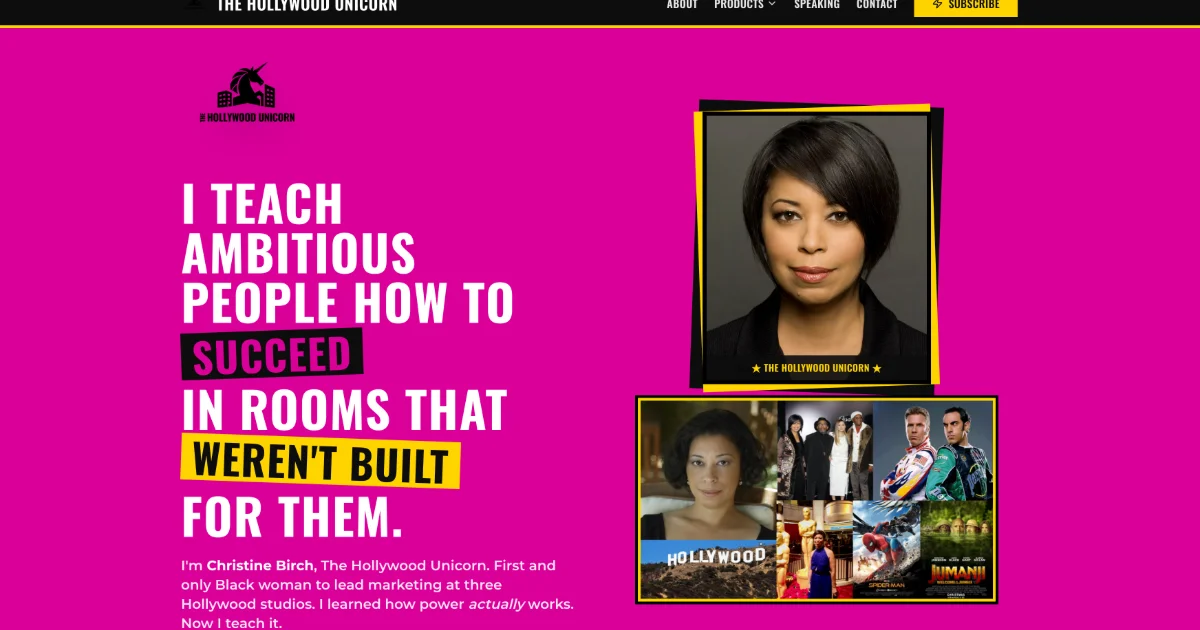
I spent 30 years in corporate America, becoming the first and only Black woman to lead Marketing at three major Hollywood studios: Sony Pictures, DreamWorks, and FilmDistrict. The cycles of progress and reversion are not new. What is new is the speed and scale of the current reversion.
The people who advance in this period are not waiting for the environment to improve. They are building the positioning, relationships, and leverage that work inside the environment that exists now.
If you want a structured framework for exactly that, the Hollywood Unicorn Corporate Cheat Codes is a set of 25 specific moves for navigating corporate environments as they actually operate, not as they're supposed to.
 Christine Birch